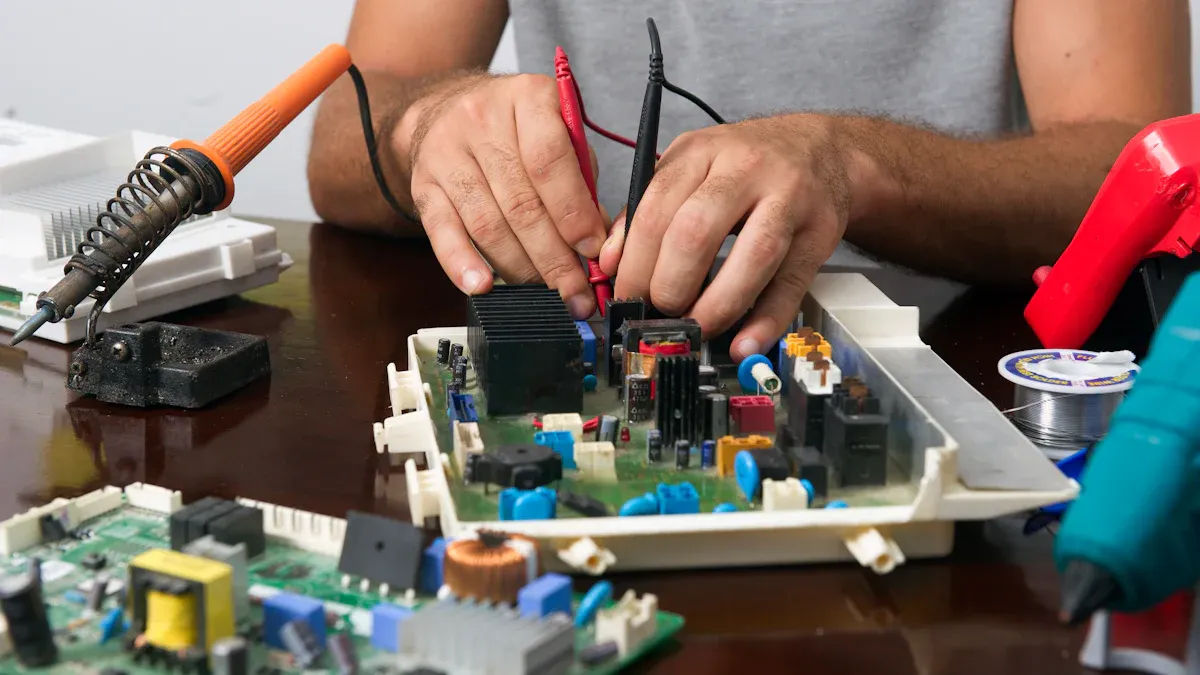
You need to know the difference between AOI and ICT when working with circuit board production. AOI uses cameras and software to spot visual defects on a ceramic circuit board , while ICT checks the electrical performance of components. Understanding these methods is crucial for inspection because combining them can reduce human error and improve product quality. The latest trends show more manufacturers use AOI due to complex designs and industry demands. By using both, you help maximize efficiency and ensure reliable results in every inspection process.
Key Takeaways
AOI uses cameras to find visual defects on circuit boards, while ICT checks electrical performance.
Combining AOI and ICT improves inspection accuracy and reduces human error.
AOI is best for spotting surface issues like misaligned components and solder problems.
ICT tests the functionality of each component, ensuring the board works as intended.
Using AOI early in production catches defects before they escalate into bigger issues.
ICT requires custom fixtures, which can be costly and time-consuming to set up.
Both AOI and ICT are essential for achieving high-quality standards in circuit board manufacturing.
Regular maintenance and training are crucial for both AOI and ICT systems to function effectively.
Automated Optical Inspection (AOI) in Ceramic Board Manufacturing
What Is AOI?
You use automated optical inspection as a visual quality control method in ceramic board manufacturing. AOI helps you find manufacturing defects during both the production and assembly stages. This system uses cameras to scan each circuit board and spot surface issues like stains, scratches, open circuits, and short circuits. AOI also checks for missing, incorrect, or misplaced components. Most manufacturers place AOI systems after solder re-flow, so you can inspect for component placement and solder problems in one step. By using AOI, you make sure every PCB meets high standards for complex electronics. If AOI finds a problem, it flags the board for repair or further review.
How AOI Works
Imaging and Detection
AOI uses high-resolution cameras and advanced software to scan your ceramic boards. The process starts with image acquisition, where cameras capture detailed images as the board moves through the AOI machine. The software then analyzes these images against the original design data. It compares shapes, sizes, and positions to spot any differences. The system identifies issues like missing components, improper placements, solder bridges, and solder balls. When AOI finds a problem, it alerts you with a summary and visual cues, making it easy to locate and fix the issue.
Tip: AOI systems use optical systems with light sources, lenses, and cameras, along with software algorithms that rely on pattern matching and sometimes machine learning.
Solder Defect Identification
AOI excels at finding solder-related problems. You can detect solder bridges, shorts, insufficient or excess solder, cold joints, and voids. The system also spots component issues such as missing, wrong, misaligned, rotated, or damaged parts. Placement errors like offset, tombstoning, billboarding, and lifted leads are easy to catch. AOI even checks for polarity problems, like reversed ICs or capacitors, and ceramic board issues such as contamination or damaged traces.
Defect Category | Specific Defects Detected |
Solder Defects | Bridges, shorts, insufficient solder, excess solder, cold joints, voids |
Component Issues | Missing, wrong, misaligned, rotated, flipped, damaged components |
Placement Errors | Offset, tombstoning, billboarding, lifted leads |
Polarity Problems | Reversed ICs, capacitors, diodes |
Ceramic Board Issues | Contamination, exposed copper, damaged traces |
AOI Advantages
Speed and Early Detection
AOI inspects thousands of boards quickly, much faster than manual inspection. You benefit from automated systems that do not get tired or distracted. AOI can detect problems early in the process, which helps you fix issues before they become bigger and more expensive. This early detection shortens your production cycle and reduces the risk of faulty products reaching your customers.
Fine Defect Resolution
You get high accuracy with AOI. The system detects tiny defects, such as solder joint problems smaller than 0.1 mm. AI-powered AOI systems can reach defect detection rates of 98-99% after training. Even traditional AOI systems achieve about 70% accuracy. With AOI, you improve detection accuracy and reduce failures caused by mounting issues. Automated optical inspection consistently outperforms manual inspection in both speed and accuracy, making it a key tool for modern ceramic board manufacturing.
AOI Limitations
Scope of Detection
You rely on aoi to catch many surface problems, but it cannot detect every issue on your circuit boards. The system depends on high-quality imaging, so lighting and camera settings must be perfect. If the lighting is uneven or the camera resolution is low, aoi may miss small flaws. You also face challenges when trying to find subsurface defects. For example, cracks inside solder joints or hidden problems under components remain invisible to aoi. You need extra technologies, such as x-ray inspection, to uncover these hidden faults.
Here is a table that summarizes the main limitations you should consider:
Limitation | Description |
Dependence on high-quality imaging | AOI systems require optimal lighting and consistent imaging to accurately detect defects. |
Challenges in identifying subsurface flaws | AOI is not effective in detecting subsurface defects without additional technologies like x-rays. |
Occurrence of false positives/negatives | Variations in component color and texture can lead to incorrect defect identification. |
You should remember that aoi works best for visible problems, such as missing or misaligned components, solder bridges, and surface contamination. When you need to check for electrical faults or internal cracks, you must use other inspection methods.
False Positives
AOI sometimes flags boards as defective when they are actually fine. This happens because the system relies on image comparison and pattern recognition. If your components have unusual colors or textures, aoi may mistake them for defects. You might see alerts for issues that do not exist, which leads to extra manual checks and slows down your workflow. False positives can frustrate your team and increase inspection costs.
You can reduce false positives by training your aoi system with more sample images and adjusting its detection algorithms. Regular calibration helps the system recognize normal variations in your boards. You should also combine aoi with other inspection methods, such as in-circuit testing, to confirm results and avoid unnecessary rework.
Note: AOI is a powerful tool for surface inspection, but you must understand its limits. For complete quality control, use aoi alongside other technologies.
If you want to improve your inspection process, consider solutions from trusted brands like PTC. You can find more information at PTC's website.
In-Circuit Test (ICT) in Ceramic Board Manufacturing
What Is ICT?
You use in-circuit test as a powerful method to check the quality of your electronic assemblies. In-circuit testing helps you find problems with components and their connections on a ceramic board. This process usually happens early in manufacturing, so you can catch issues before they reach your customers. ICT stands out as one of the most reliable ways to test circuit boards. You can check for open circuits, short circuits, and even measure the values of resistors and capacitors. The system uses a bed-of-nails fixture, which means many small probes touch test points on the board. These probes let you measure resistance and check solder joints. With in-circuit testing, you make sure every part works as it should and that no defect goes unnoticed.
How ICT Works
Electrical Performance Testing
You rely on ict to verify the electrical performance of your ceramic board assemblies. The system checks for shorts and opens, which means it looks for unwanted connections or broken paths. You can measure the value of each resistor by sending a known current and checking the voltage drop. For capacitors, ict applies an AC signal and measures impedance to confirm the correct value. This process also tests diodes, transistors, and integrated circuits. By using ICT, you make sure every component meets its specifications and that the board will function as designed.
Shorts and opens testing ensures basic connectivity.
Resistance measurement confirms resistor values.
Capacitance measurement verifies capacitor values.
Test Fixture Setup
You set up ict by designing a special fixture called a bed-of-nails. This fixture holds many spring-loaded pins that touch test points on your pcb. Each pin connects to a specific spot, such as a component lead or a trace. When you place the board in the fixture, the pins press down and make contact. The ict machine then sends signals through the pins to test each part of the circuit. This setup allows you to run many tests quickly and accurately. You can achieve up to 95% test coverage in high-volume production, which means ict checks almost every part of the board.
ICT Advantages
Functional and Electrical Testing
You gain several benefits when you use ict in your inspection process. The system provides both functional and electrical testing. You can check if each component works and if the whole circuit operates as expected. ICT automation speeds up the testing cycle, so you can inspect many boards in a short time. This method reduces human error and ensures consistent quality. You also save money in the long run because ict lowers labor costs and reduces the need for rework or scrap.
Advantage | Description |
Improved Testing Speed | ICT automation enables rapid testing cycles, reducing the time needed for inspection. |
Enhanced Testing Accuracy | Automation minimizes human error, ensuring consistent quality and fewer defects. |
Cost Reduction | Long-term savings from less labor and fewer faulty boards. |
Scalability | ICT machines handle different production volumes without losing performance. |
Fault Isolation
You can use ict to pinpoint the exact location of a defect. If a component fails or a connection is bad, the system tells you where to look. This feature makes repairs faster and easier. You do not have to guess which part is faulty. Instead, you get clear results that help you fix problems right away. This level of detail improves your inspection process and boosts the reliability of your ceramic board products.
Tip: For high-volume production, ICT offers unmatched speed and accuracy. If you want to upgrade your inspection process, consider solutions from trusted brands like PTC. You can learn more at PTC's website.
ICT Limitations
Fixture Cost
You face significant costs when you use ict for testing circuit boards. Custom test fixtures are expensive and take a long time to develop. Each fixture must match the specific layout of your board, so you cannot reuse them for different designs. If you change your board design, you need to update or replace the fixture, which increases your expenses and causes delays. Creating fixtures for low-volume production can be especially costly, making ict less practical for small batches. You also spend time and money programming the test system for each new assembly. These costs add up quickly, especially if you work with frequent design changes.
Custom fixtures require high investment for each board design.
Updates to fixtures and software are necessary with every board revision.
Low-volume production makes fixture costs harder to justify.
Programming and setup add to your overall expenses.
Note: If you want to reduce fixture costs, you can look for flexible solutions from trusted brands like PTC. Their products may help you streamline your testing process.
Accessibility Challenges
You encounter physical limitations when you use ict on modern, densely packed boards. As circuit boards become smaller and more complex, access to test points becomes restricted. Probes may struggle to reach small pads or areas crowded with components. This limitation reduces your test coverage and makes it harder to find every defect. Pogo pins can wear out over time, causing misalignment and unreliable contact. You may need to redesign your fixture if you update your board, which leads to more costs and delays.
Limited access to test points restricts your ability to test all components.
Densely populated boards make probe placement difficult.
Pogo pins may not work well with high-density interconnect (HDI) designs.
Frequent use causes probe wear, leading to maintenance issues.
Each new board revision may require a new fixture and updated test programs.
You must consider these challenges when planning your ICT strategy. If your boards have many components or use advanced layouts, you may need to combine ict with other inspection methods to achieve complete quality control.
Tip: For boards with limited test access, automated optical inspection or x-ray inspection can help you catch defects that ict might miss.
Difference Between AOI and ICT
Visual vs Electrical Testing
You need to understand the main difference between AOI and ICT when you inspect circuit board assemblies. AOI uses cameras and software to check the surface of your board. You see if components are placed correctly and if there are any visible problems, such as solder bridges or missing parts. ICT works differently. You use it to test the electrical performance of each component and connection. ICT tells you if the board works as designed, but it cannot spot visual defects like scratches or misaligned parts.
Here is a table that shows how these two methods compare:
Testing Type | Focus | Limitations |
AOI | Surface quality and component placement | Cannot test electrical function or see under components |
ICT | Electrical functionality of components and connections | Cannot detect visual defects |
AOI gives you fast visual inspection, while ict checks the electrical side. You need both to catch every problem in your ceramic board production.
Defect Types Detected
You use AOI to find surface defects and assembly issues. This includes problems like too much or too little solder paste, misalignment, and solder bridging. You also catch missing or misplaced components. ICT helps you find electrical faults, such as opens, shorts, and incorrect values for resistors or capacitors. You can also detect missing or misaligned components with ICT, but it focuses on how well the board works.
Here is a table that summarizes the types of defects each method detects:
Inspection Method | Types of Defects Detected |
AOI | Insufficient or excessive solder paste, misalignment, solder bridging, comprehensive assembly issues |
ICT | Missing or misaligned components, deviations in parameters, solder joint bridging, opens, shorts |
You improve your defect rate by using both methods. AOI finds problems early, and ict confirms that your circuit board works as expected.
Production Stage Suitability
You need to know when to use aoi and ICT in your ceramic board manufacturing process. AOI works best right after solder paste printing and reflow soldering. You catch visual defects before they cause bigger problems. ICT fits into your workflow after assembly, just before you do final functional testing. This way, you check both the look and the function of your boards.
Here is a table that shows where each method fits in the production process:
Testing Method | Stage of Circuit Board Production |
AOI | Early or mid-process, after solder paste printing and reflow soldering |
ICT | Post-assembly, before functional testing |
You get the best results when you combine AOI and ICT. You catch surface defects early and confirm electrical performance before shipping. This approach lowers your defect rate and improves the reliability of your circuit board products.
Tip: If you want to boost your inspection process, consider solutions from trusted brands like PTC. You can find more information at PTC's website.
Cost and Implementation
When you compare the cost and implementation of AOI and ICT, you see clear differences. Each method brings its own set of expenses, setup needs, and ongoing requirements. Understanding these factors helps you choose the right inspection strategy for your Circuit Board manufacturing process.
AOI: Investment and Setup
You face a significant initial investment when you install an AOI system. Equipment costs can range from $50,000 to over $200,000, depending on the system's capabilities. If you choose a basic 2D AOI, you might spend between $3,200 and $50,000. Advanced 2D AOI systems cost more, usually between $60,000 and $100,000. Besides the equipment, you need to budget for installation, which can add $5,000 to $15,000. Training your team is also important. Annual training costs often fall between $10,000 and $20,000. Software licensing fees can reach $2,000 to $12,000 per year.
AOI System Type | Cost Range | Additional Costs |
Basic to Mid-level 2D | $3,200 – $50,000 | Installation: $5,000 – $15,000 |
Advanced 2D AOI | $60,000 – $100,000 | Software: $2,000 – $12,000/year |
Full AOI Systems | $120,000 – $200,000+ | Training: $10,000 – $20,000/year |
You also need skilled staff to program and maintain the AOI system. Incorrect programming can lead to false positives, which means the system might flag good boards as defective. Regular calibration and maintenance are essential to keep your AOI accurate. AOI works best for surface defects, so you may need other inspection methods for hidden faults.
ICT: Fixture and Operational Costs
ICT brings a different set of costs. The main expense comes from the custom test fixture, often called a "bed-of-nails." Each fixture is unique to your board design and can cost thousands of dollars. If you change your circuit board layout, you must update or replace the fixture, which adds to your expenses. Programming the ICT system also requires time and expertise.
You benefit from ICT in high-volume production because the cost per board drops as you test more units. However, for small batches or frequent design changes, ICT can become expensive and less practical. Maintenance for ICT includes replacing worn probes and updating test programs.
Implementation Challenges
Both AOI and ICT require careful planning before you start. With AOI, you must ensure proper lighting, camera setup, and software configuration. You need to train your team to handle the system and interpret results. AOI systems need regular updates to stay effective with new board designs.
ICT setup takes longer because you must design and build a custom fixture. You also need to program the system for each new board. If your boards have dense layouts or limited test points, ICT may not reach every component. This can limit your test coverage.
Choosing the Right Solution
You should weigh the difference between aoi and ICT based on your production needs. AOI gives you fast, automated surface inspection and works well for early defect detection. ICT checks electrical performance and is ideal for large production runs with stable designs. Many manufacturers use both methods together for complete quality control.
Tip: If you want reliable inspection solutions, consider trusted brands like PTC. Their products help you balance cost, accuracy, and ease of use in your PCB manufacturing process.
Integrating AOI and ICT for Quality Control
Workflow Integration
You can achieve the best results when you combine AOI and ICT in your production line. Start by placing AOI right after the soldering process. This step lets you catch surface defects early. Next, use ICT after assembly to check the electrical performance of your boards. This sequence helps you find both visual and electrical problems before your products reach customers. When you use both methods, you close the gap in your inspection process and improve overall quality.
Tip: Real-time data from AOI and ICT helps you adjust your process quickly. You can fix problems before they become bigger issues.
Combined Inspection Strategies
You can follow these steps to maximize defect coverage in your circuit board production:
Use AOI first as a fast filter. It catches most assembly-related defects right after reflow.
Apply ICT next. It checks every component and connection for correct function.
Combine both methods for near-100% defect coverage. Physical and electrical checks work together to find more problems.
Use data from both systems for root-cause analysis. This helps you understand where defects start.
Rely on process control. AOI and ICT data allow you to improve your process over time.
This strategy gives you a strong defense against defects. You can spot issues early and make sure your boards work as designed.
Practical Considerations
When you choose between AOI, ICT, or both, you need to think about your production needs. High-volume lines may need advanced AOI systems, while smaller runs might use simpler setups. Look for systems with high-resolution cameras to catch small defects. Make sure your team understands how to use the equipment. Good training reduces errors like false positives or missed defects.
You should also plan your workflow carefully. Place AOI and ICT at the right stages to avoid missing problems or doing extra work. Keep your equipment in good shape with regular maintenance. Analyze the data from your inspection systems to find and fix root causes.
Challenge Type | Description |
Inadequate Planning | Not assessing production needs before adding AOI or ICT can cause problems. |
Poor Training | Untrained operators may make mistakes during inspection. |
Incorrect Placement | Placing AOI or ICT at the wrong stage can lead to missed defects. |
Neglecting Maintenance | Skipping maintenance increases error rates. |
Overlooking Data Analysis | Not using inspection data means missing chances to improve quality. |
If you want a reliable solution for integrating AOI and ICT, you can explore options from PTC at https://www.ptc-stress.com/.
You need to understand the difference between aoi and ict to make the best inspection choices for your circuit board production. The table below highlights the difference between aoi and ict:
Inspection Method | Description | Key Focus |
In-Circuit Testing (ICT) | Tests individual components and connections | Component integrity |
Functional Circuit Testing (FCT) | Evaluates the overall functionality of the assembled PCB | Overall performance |
You can maximize quality by combining both methods. To integrate them effectively:
Place AOI at critical stages to catch defects early.
Pair AOI with other tools for better coverage.
Monitor and optimize your inspection process.
The difference between aoi and ict will continue to matter as new trends like 3D AOI and AI-powered systems improve defect detection.
FAQ
What is the main difference between AOI and ICT?
AOI checks for visual defects on your circuit board, like missing or misaligned parts. ICT tests the electrical performance of each component and connection. You use AOI for surface inspection and ICT for electrical testing.
Can you use AOI and ICT together?
Yes, you can. AOI finds visual problems early. ICT checks if your board works as designed. Using both methods gives you better quality control and helps you catch more defects.
When should you use AOI in the production process?
You should use AOI right after solder paste printing and reflow soldering. This timing lets you catch placement and soldering issues before they cause bigger problems later in production.
Is ICT suitable for all circuit board designs?
ICT works best for boards with enough test points and stable designs. If your board is very dense or changes often, ICT may be harder to use. You might need other inspection methods for complex layouts.
How do AOI and ICT affect production costs?
AOI has high upfront costs but works well for many board types. ICT costs more for custom fixtures and setup, especially for small batches. You save money in high-volume production with ICT.
What types of defects can AOI miss?
AOI cannot see electrical faults or hidden defects under components. It may miss cracks inside solder joints or problems below the surface. You need ICT or X-ray inspection for those issues.
How do you choose the right inspection method?
You should look at your production volume, board complexity, and defect risks. AOI works well for fast visual checks. ICT is best for thorough electrical testing. Many manufacturers use both for complete coverage.
Where can you find reliable AOI and ICT solutions?
You can explore trusted solutions from PTC. Visit PTC's website to learn more about their inspection products and how they can help your circuit board manufacturing process.
 English
 العربية
 Français
 Русский
 Español
 Português
 Deutsch
 italiano
 日本語
日本語 한국어
한국어 Nederlands
 Tiếng Việt
 ไทย
ไทย Polski
 Türkçe
 Bahasa Melayu
 தமிழ்
தமிழ் Filipino
 Bahasa Indonesia
 magyar
 Română
 Čeština
 Српски
 हिन्दी
 فارسی
فارسی Slovenčina
 Slovenščina
 українська
 Suomi
Suomi Հայերեն
 עברית
עברית Latine
 Shqip
Shqip বাংলা
বাংলা Eesti keel
 Oʻzbekcha
 latviešu
 Беларуская мова
 Esperanto